What Makes RC Helicopters Harder Than Drones?
Flying an RC helicopter is a different beast compared to drones. Unlike drones, which use multiple rotors and complex flight controllers to stabilize themselves automatically, RC helicopters rely on your input to maintain balance and direction. The pilot must manage collective pitch, throttle, cyclic, and tail rotor simultaneously. This requires more nuanced hand coordination and a deeper understanding of aerodynamics.
Most beginners struggle with the sensitivity of the controls and the helicopter's tendency to drift or spin if not managed carefully. However, modern RC helicopters now come equipped with 6-axis gyros and sometimes optical flow sensors that help stabilize flight, making the learning curve less steep. Still, flying a helicopter demands more attention to detail and practice than most drones.
Understanding Controls: Throttle, Rudder, and Cyclic
RC helicopter controls may seem overwhelming at first, but breaking them down helps. The transmitter sticks usually operate in Mode 2:

-
Left Stick: Controls throttle (up/down) and yaw/rudder (left/right rotation)
-
Right Stick: Controls cyclic pitch—forward/backward and left/right movements
The throttle raises or lowers the main rotor speed, which controls altitude. The rudder controls the tail rotor, preventing unwanted spins and allowing you to rotate the helicopter on its vertical axis. Cyclic controls tilt the main rotor disc to move the helicopter forward, backward, or sideways.
Understanding how these inputs interact is key. For example, increasing throttle without adjusting cyclic can cause the helicopter to climb but drift. Coordinated control inputs keep the helicopter stable.
4-Channel vs 6-Channel Helicopters for Beginners
Beginners often ask whether to start with a 4-channel (4CH) or 6-channel (6CH) helicopter. Here's the breakdown:
-
4CH: Controls throttle, yaw, and simple forward/backward and left/right movements. Usually fixed-pitch rotors, meaning blade pitch doesn’t change. Easier to learn, more stable, ideal for outdoor beginners.
-
6CH: Adds collective pitch control, allowing blade pitch adjustments for more realistic and agile flight. Offers aerobatics and precise control but requires more skill and experience.
Most adults learning how to fly RC helicopter beginner models should start with 4CH. It builds confidence without overwhelming complexity.
Pre-Flight Checklist
Before every flight, run through these essential checks to avoid crashes and damage:

-
Battery: Fully charged and securely connected. Low voltage reduces lift and control responsiveness.
-
Gyro Calibration: Place the helicopter on flat ground and let the gyro initialize without moving it. This prevents drift.
-
Rotor and Tail Blades: Inspect for cracks, chips, or warping. Damaged blades cause vibration and instability.
-
Flight Area: Choose a clear, open space free of people, pets, and obstacles.
-
Wind Conditions: Avoid flying in strong or gusty winds. Light, steady breezes are acceptable once you master basic control (Wind Flying Guide).
How to Take Off Safely
Takeoff is often the most nerve-wracking moment for beginners. Start by slowly increasing throttle until the helicopter lifts 20–30 cm off the ground. Keep the controls steady and avoid sudden inputs. At this low altitude, focus on maintaining a stable hover rather than moving around.
Most beginners find it helpful to keep the helicopter tail-in (tail facing you) to make directional control more intuitive. Avoid pushing throttle too high too quickly; gradual lift reduces the chance of overcorrection and crashes.
How to Hover
Hovering is the foundation of all helicopter flight. Your goal is to keep the helicopter stationary in the air, maintaining altitude and position with minimal drift. This requires subtle adjustments to throttle, cyclic, and rudder.

Hovering practice builds muscle memory and spatial awareness. For a detailed step-by-step approach, check out our How to Hover Guide.
How to Land
Landing is simply controlled descent with steady throttle reduction. Keep the helicopter aligned with your position and reduce altitude slowly. Avoid rushing to the ground, which can cause hard landings and damage blades or gears.
Always keep the helicopter level and tail-in during landing for better control. If the helicopter drifts, gently correct with cyclic inputs while lowering throttle.
Flying Outdoors in Light Wind
Flying outside adds realism but also challenges like wind. Beginners should stick to calm days or light breeze conditions. Wind affects stability, so anticipate drift and counter with rudder and cyclic adjustments.

Our Wind Flying Guide covers how to read wind conditions and adjust your flying style accordingly.
Common Beginner Mistakes
Many new pilots make similar errors that slow progress:
-
Over-correcting controls: Panicking and pushing sticks too far causes oscillations. Solution: make small, smooth corrections (Common Beginner Mistakes).
-
Flying indoors with outdoor helicopters: Outdoor models need space and airflow; indoor flying requires different models.
-
Ignoring gyro calibration: This leads to drifting and unstable flight.
-
Flying with damaged blades: Causes vibration and loss of control.
-
Trying advanced maneuvers too soon: Stay low and slow until basics are mastered.
What to Do After a Crash
Crashing is part of learning. After a crash:

- Turn off the helicopter and remove the battery.
- Inspect main and tail blades for cracks or warping.
- Check for loose screws or damaged gears.
- Recalibrate the gyro before the next flight.
- Replace damaged parts promptly to avoid further issues.
Refer to our Troubleshooting Hub for detailed fixes.
Recommended Beginner Models
Choosing the right helicopter is critical. Here’s a comparison of some top beginner-friendly models we recommend for 2025:
| Model |
Channels |
Gyro Type |
Flight Time |
Wind Tolerance |
Price Range |
Notes |
| C186 Pro RC Helicopter |
4CH |
6-Axis Gyro |
8-10 minutes |
Light breeze (up to 5 mph) |
$$ |
Stable, easy to control, ideal first helicopter for outdoor flying |
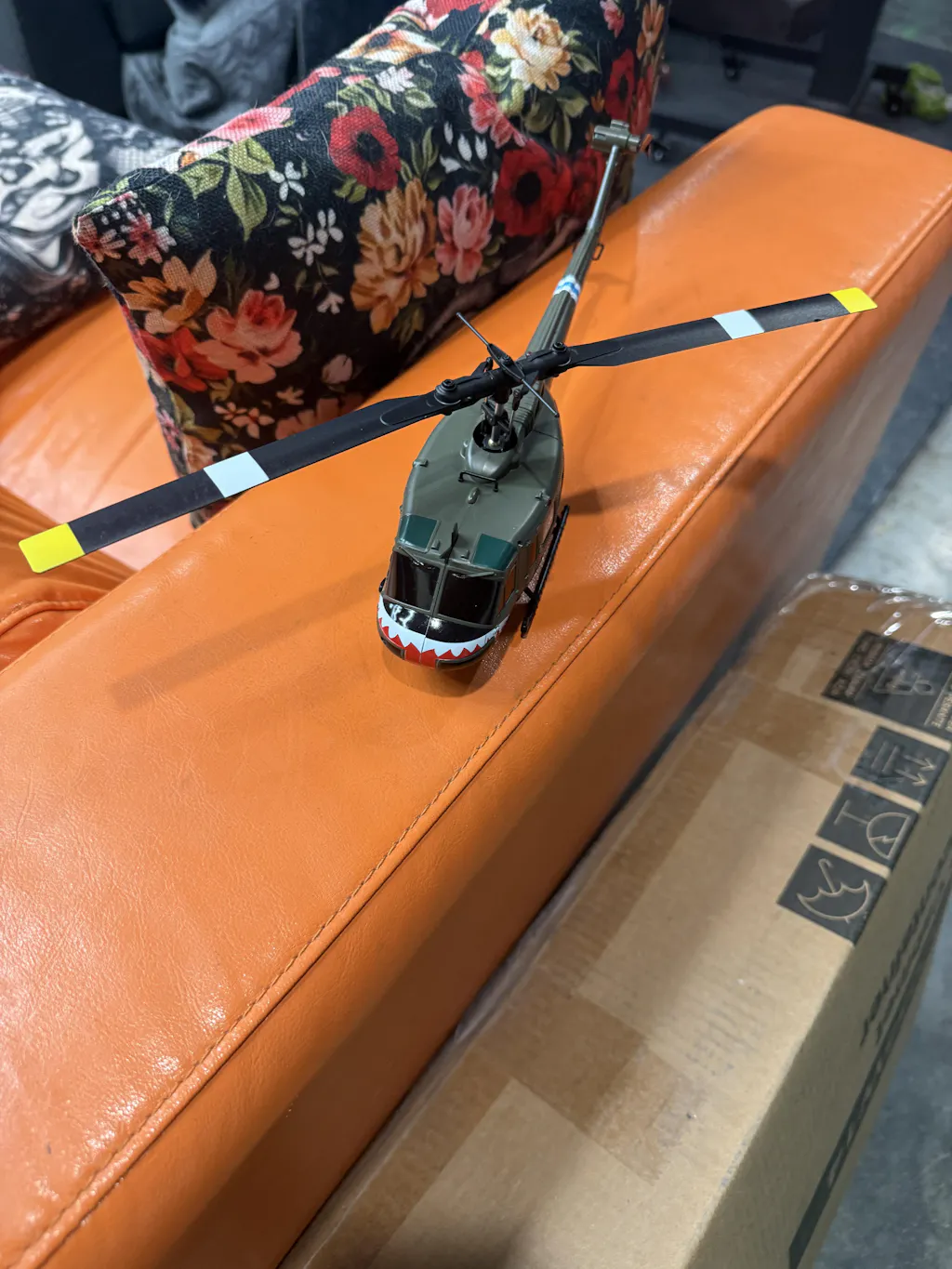
| RC Huey UH-1 Helicopter |
6CH |
Advanced Gyro + Optical Flow |
10-12 minutes |
Moderate wind (up to 8 mph) |
$$$ |
Great upgrade path, realistic scale model, requires some experience |
| C184 MD500 Helicopter |
4CH |
6-Axis Gyro |
7-9 minutes |
Light breeze (up to 5 mph) |
$ |
Budget option, durable, good for indoor and outdoor beginners |
Not Ideal For
- Those expecting instant mastery without practice. RC helicopter flying demands patience.
- People with limited hand-eye coordination or slow reflexes.
- Flying in crowded or windy urban areas.
- Beginners who want aggressive aerobatics immediately (collective pitch helicopters require skill).
Your Next Steps After Learning the Basics
Once you’re comfortable hovering, taking off, and landing in calm conditions, start expanding your skillset:
- Practice basic directional control with tail-in orientation.
- Try gentle turns and figure-8 patterns to build spatial awareness.
- Fly in light wind to develop wind compensation skills (Wind Flying Guide).
- Explore indoor vs outdoor flying benefits to choose your preferred environment (Indoor vs Outdoor Guide).
- Upgrade to more advanced helicopters like the RC Huey UH-1 when ready.
For a broader perspective on adult RC helicopter flying, check our Adults Ultimate Guide.
Frequently Asked Questions
Q: How long does it typically take to learn basic RC helicopter flying?
A: Most adults can achieve stable hovering and controlled flight within a few hours of focused practice. Mastery of outdoor flying and wind handling may take several weeks.
Q: Can I fly RC helicopters indoors?
A: Yes, but only specific models designed for indoor flight like coaxial helicopters. Larger outdoor helicopters are not suitable for confined spaces due to their size and airflow requirements.
Q: What’s the difference between fixed-pitch and collective-pitch helicopters?
A: Fixed-pitch helicopters have blades with a fixed angle, making them easier to fly but less maneuverable. Collective-pitch helicopters allow blade angle changes, enabling aerobatics but requiring advanced skills.
Q: How important is gyro calibration?
A: Critical. Improper gyro calibration leads to drifting and unstable flight. Always calibrate on level ground before flying.
Q: What should I do if my helicopter spins uncontrollably?
A: Check the tail rotor and motor for damage or looseness. Recalibrate the gyro and ensure the tail blades are intact. Refer to our Troubleshooting Hub for detailed steps.
Q: Are spare parts easy to find for beginner helicopters?
A: Yes, popular beginner models like the C186 Pro have widely available spare blades, batteries, and replacement parts, which is essential for learning safely.
Browse RC Helicopters →